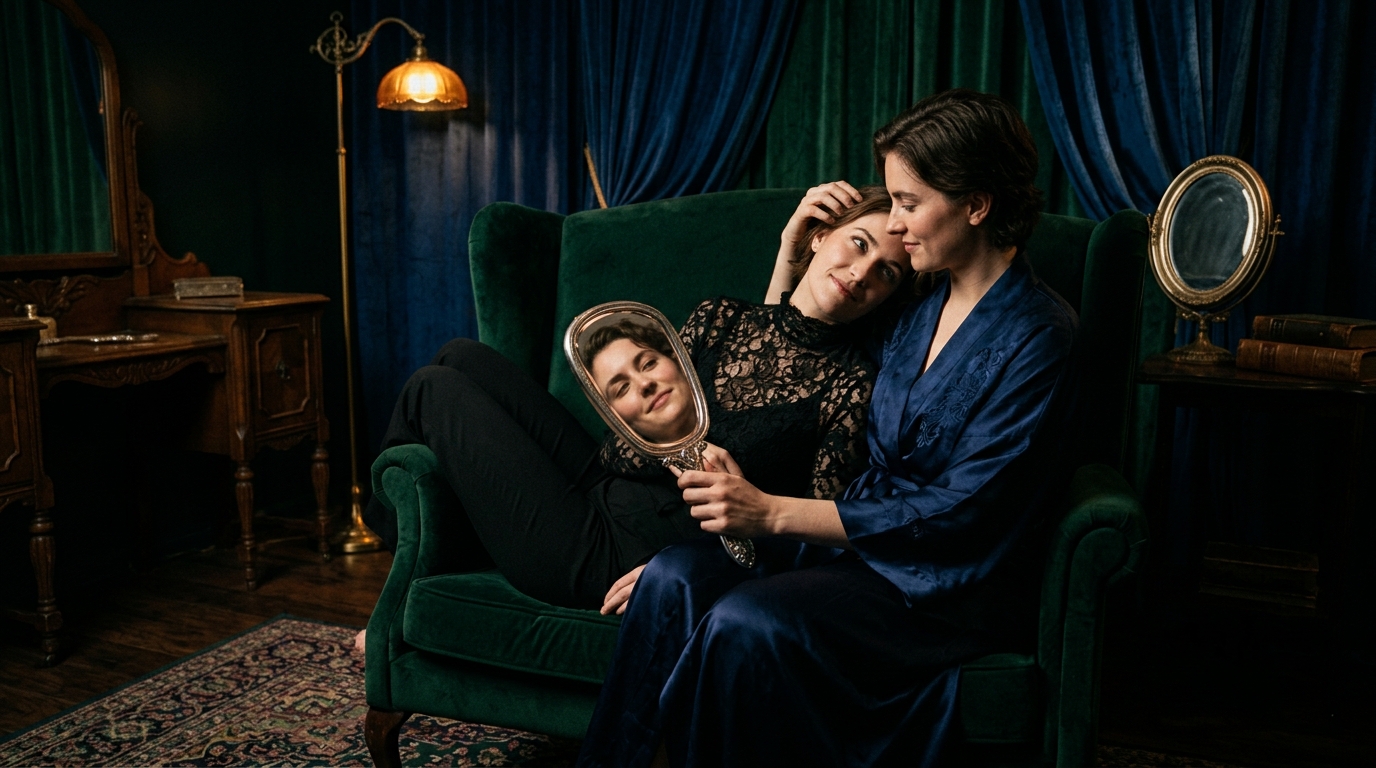

“He just wants to watch, but I want to be watched.”
It was a whisper, barely audible over the hum of the highway, but it landed in the quiet space between them in the car like a dropped stone. Not an accusation, not a complaint, but a low, exhausted sigh from someone who’d spent too long trying to solve a puzzle with mismatched pieces. They’d been together for years, carved out a life that looked good on paper – shared finances, shared chores, shared Netflix queue. But in the bedroom, or more precisely, in the dark corners where true desire lives, they found themselves on opposite sides of a window. He, drawn to the quiet, almost scientific pleasure of observation, of seeing her. And she, craving the hot, consuming thrill of being seen, of being the spectacle, the focus, the absolute center of a hungry gaze. It’s not just about what you want to do; sometimes, it’s about what you need to be for someone. And when those needs pull in different directions, the quiet can become a chasm.
We talk a lot about the push and pull of desire, about the ebb and flow. But what happens when the direction of the flow is reversed? When one partner’s engine is revved by the act of watching, soaking in the visual feast, finding satisfaction in the distance of observation, while the other craves the heat of the spotlight, the intensity of being the observed? This isn’t a battle of active versus passive; it’s a collision of internal landscapes, two distinct pathways to arousal that can leave both parties feeling unseen, misunderstood, or worse, like their specific brand of turn-on is somehow ‘wrong.’ The world of voyeurism and exhibitionism isn’t a simple binary; it’s a spectrum of deeply personal experiences, and sometimes, our internal wiring just doesn’t line up with the person we share a bed with.
Stop Negotiating Desire Like a Chore Chart
The biggest mistake couples make when these differences surface is to treat them like a negotiation over who takes out the trash. “Okay, so you watch me tonight, and then next week, I’ll let you watch me with that toy you like.” That kind of transactional thinking kills desire faster than a tax audit. Desire isn’t a duty; it’s a fickle, wild thing that responds to authenticity and genuine connection, not quid pro quo. When you start trying to balance the scales of who gets what, who’s “doing” for whom, you strip the act of its inherent erotic charge. You turn intimacy into a task, and who gets off on a task?
The problem isn’t the difference itself; it’s the silence around it, or the awkward, clinical language people fall into. She feels selfish for wanting to be the star; he feels perverted for just wanting to watch. Both are wrong. There’s no moral failing in your specific flavor of eroticism. The real failure is in not being able to articulate it, or in not creating a space where it can be heard without judgment. She’s not trying to diminish his pleasure by wanting to be watched; she’s just trying to feel hers. He’s not trying to evade connection by observing; he’s trying to connect in a way that truly ignites him. The conversation has to start from a place of radical empathy, not perceived obligation.
“I love watching you,” he might say, “it really turns me on to see you like that. But sometimes, I feel like you need more from me, and I’m not sure I always know how to give it to you when I’m so caught up in just looking.”
And she could respond, “When you just watch, sometimes I feel like I’m performing for an audience, not being desired by you. I want to feel your eyes on me, yes, but I also want to feel you wanting me, not just the scene.”
Notice the difference: no blame, no “you make me feel.” It’s “I feel X when Y happens,” and an honest attempt to explain the internal experience without judgment. This is a difficult conversation, yes, but infinitely more productive than simmering resentment or forced performances.
Desire isn’t a Zero-Sum Game
This isn’t a case of “either/or.” It’s a challenge to expand the understanding of both your partner’s pleasure and your own. His voyeurism doesn’t inherently negate her exhibitionism, and vice-versa. In fact, they can be deeply complementary. The voyeur needs something to watch, and the exhibitionist needs someone to watch. The disconnect often comes from a misunderstanding of the quality of the gaze.
He might be watching her, but if she feels he’s watching her as a detached observer, like a nature documentary, then her exhibitionistic needs aren’t met. She wants to be seen as desirable, as the object of his specific, personal hunger, not just a generic beautiful body. His task, then, isn’t to stop watching, but to infuse that gaze with the raw, unmistakable language of personal desire. This could mean verbalizing what he sees, whispering his reactions, or letting his body language convey the intensity of his arousal while he watches. It’s about engagement, even from a distance.
For her, the counterintuitive truth might be this: sometimes, the most potent exhibitionism isn’t about being the absolute, unwavering center of attention, but about allowing the observer his space to truly savor. It’s about creating a scene not just for her own thrill, but for the shared thrill of it being observed. This isn’t about diminishing her experience, but about recognizing that his genuine pleasure in watching can amplify hers. It means trusting that his quiet observation is a form of intense desire, not a lack of it. It requires a deeper intimacy, where she knows his gaze is laden with hunger, even if he’s not physically all over her in that moment.
Maybe she sets up the camera, not for him to operate, but for her to perform to, knowing he’ll be watching the playback later, a private show just for his eyes. Or perhaps they integrate touch with observation, where his hands are on her, but his eyes are fixed on their reflection in a mirror, allowing both modes of arousal to coexist.
Further reading: how to communicate sexual desires in a long-term relationship without conflict in 2026 · The Hammock on the Lanai: tropical breezes and whispered secrets. · 5 ways to maintain sexual desire in a long-term relationship despite external stress
Drop the Polite Fictions
It’s easy to settle into a rhythm of polite fictions in long-term relationships. We tell ourselves “we’re just tired,” or “we’ve been busy,” or “it’s not a big deal.” We shrink our true erotic selves to fit the comfortable, non-confrontational mold of domestic partnership. But the truth is, those small suppressions, those unspoken desires, they don’t just disappear. They fester. They turn into quiet disappointments, or worse, they become the subtle drivers pushing us to seek satisfaction elsewhere, online, or in the silent corners of our own minds.
It’s a brave thing to say, “I want to be looked at by you, like I’m the only fucking thing that exists in the world.” Or, “I get off on watching you, really watching, and I need that space to feel truly aroused.” These aren’t easy words to say, because they expose vulnerability, they lay bare the raw, sometimes odd, truth of our desires. They challenge the polite agreement that intimacy should always look a certain way.
But this is Sexarium. We’re here to say that the messy, complicated, sometimes contradictory truths of desire are the most compelling ones. The most profound acts of intimacy often begin with an honest, awkward, and fearless admission of what you truly need, even if it feels a little outside the lines. So, stop protecting your partner from the truth of your wanting, and stop protecting yourself from the truth of theirs. Tell them what you truly crave, what makes your body hum, what specific flavor of observation or exhibition makes you feel alive. Because the alternative — a lifetime of quiet dissatisfactions — is a much harder burden to carry.