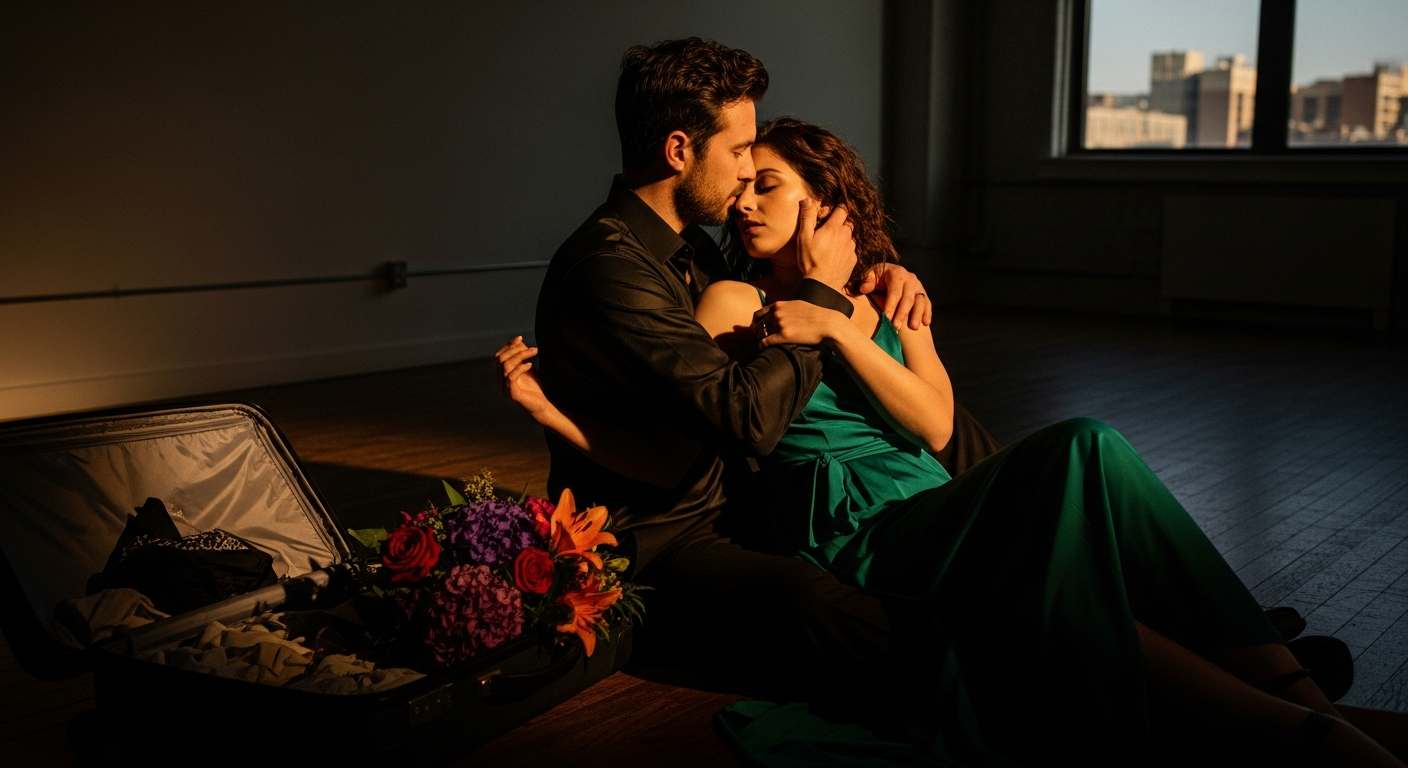

The late afternoon light, a thin, buttery gold, stretched across the oak floorboards of the salon, illuminating dust motes dancing in the quiet air. She watched him from the armchair, a book resting unread in her lap. He was at the window, ostensibly looking out at the Parisian rooftops, but his shoulders were subtly hunched, a familiar tension in the line of his spine that spoke volumes beyond the silent view. A silence that hummed with a different kind of curiosity, one that had less to do with the external world and more with the interior cartography of their shared decades.
One might imagine that after years, or even a decade, the landscape of a body becomes entirely mapped, every peak and valley catalogued, every fertile patch charted. We speak often of the comfort of familiarity, the deep ease of a known touch, and indeed, there is a profound pleasure in this. But the discourse, particularly in its Anglo-American iterations, often frames this as a completion, a project finished. It’s as if desire, once settled into its rhythms, ossifies, a predictable itinerary rather than a living, shifting terrain. What is rarely spoken of, and perhaps less frequently explored with true attentiveness, is the exquisite delight of uncovering new nerve endings, unexpected pockets of sensation, long after one presumes the atlas is complete.
The Illusion of Knowing
It’s an odd presumption, this idea that a person, once intimately known, presents no further frontiers. We do not apply this logic to art, or to cities. One might walk the same arrondissement for twenty years and still discover a new café tucked into a forgotten alley, a fresco hidden above a boulangerie. Why, then, do we so readily apply a sort of finite limit to the human body, particularly when it comes to pleasure? Perhaps it is the very intimacy, the perceived omniscience, that blinds us. The routine, comforting as it is, can become a kind of soft-focus lens, blurring the fine details, the nuances of an evolving landscape.
Consider the subtle shifts. A scar, appearing unexpectedly from an old injury, can alter the way skin responds. The changing architecture of muscle and fat with age, the quiet deepening of lines around the eyes, each can redistribute sensation, awaken dormant pathways. But it’s not merely the biological recalibrations. It is the shifting currents of a shared life, the unspoken pacts, the small daily betrayals and redemptions that also sculpt the interior world of sensation. A hand that once traced a familiar curve with casual affection can, with a renewed intention, a different pressure, awaken an entirely new register of pleasure in a place previously considered inert.
The Unfurling Map
There is a particular vulnerability, an exquisite kind of surrender, in allowing someone who knows you so well to touch you as if for the first time. It requires a shedding of assumptions, a deliberate forgetting of past maps. It’s an invitation to explore without the pressure of performance, without the expectation of a known outcome. This is where the truly thrilling discoveries lie. Not in the dramatic, overt gestures, but in the slow, deliberate exploration of what lies between the celebrated erogenous zones. The inner wrist, perhaps, where the pulse beats a delicate rhythm, suddenly alive to the lightest brush of a fingernail. Or the small hollow behind the ear, a forgotten valley now resonant with a whispered word.
These are not grand, anatomical revelations but micro-discoveries, often contingent on context, on mood, on the precise inflection of a gaze. The way a certain fabric, unlined silk perhaps, brushing against the small of the back, can, when accompanied by a specific quality of attention, ignite a low, humming current. Or the cool touch of a glass of white wine against the thigh, in a moment of shared, illicit humor, becoming an unexpected spark. These moments are less about technique and more about presence, about a shared willingness to be surprised, to re-learn.
The eroticism of this rediscov
Readers also explore: how to maintain desire in long-term relationships during polycrisis stress · how to build sexual confidence after a long-term relationship ends in 2026 · 7 ways to maintain sexual spontaneity in long-term relationships despite busy schedules ery lies, too, in its implicit acknowledgement of growth, of continuous transformation. It’s a quiet rebellion against the notion that love, or desire, must become static, a museum piece. It suggests, rather, that intimacy is an ongoing conversation, a constantly rewritten text. This is a far cry from the modern obsession with ‘optimization’ or ‘enhancement’ – those sterile terms that reduce human connection to a checklist of performance metrics. There is no productivity hack for the unexpected shiver, no algorithm for the sudden awareness that a particular spot on the neck, long taken for granted, now hums with a delightful sensitivity under a lover’s breath.
It demands a kind of elegant patience, a mutual permission to linger without immediate objective. To trace a line on an arm not with the goal of arousal, but with the quiet wonder of sensation itself. To watch the other’s face, to observe the tiny tells – the slight parting of the lips, the flutter of an eyelid, the almost imperceptible tensing of a muscle – that signal a new ignition. This is the luxury of duration: the time and the trust to experiment without pressure, to fail delightfully, to discover the small, exquisite tremors that populate the periphery of the known.
He shifted at the window, finally turning, the late sun catching the silver in his hair. His eyes, the color of wet slate, met hers across the room. There was a faint, almost imperceptible smile playing at the corner of his mouth, a question held there, unspoken. She lowered the book, slowly, deliberately, her gaze holding his. The gold dust motes still danced, but the air, suddenly, held a different charge. A small, silent click of a latch, somewhere deep inside, inviting entry.