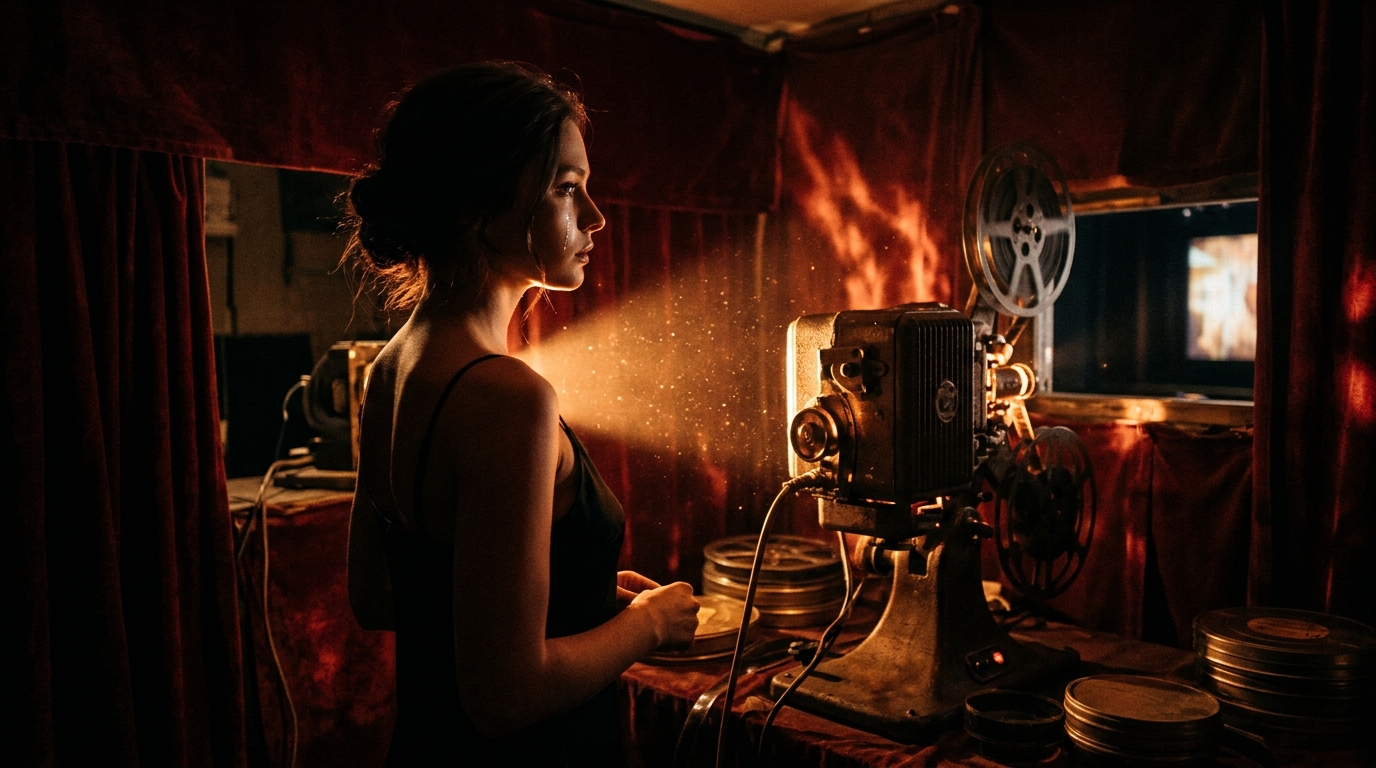
The air in the projectionist’s booth hung thick with dust motes and the sweet, hot smell of old celluloid. Outside, the last credit sequence of The Red Desert flickered on the screen, illuminating rows of empty velvet seats. Elias adjusted the focus one last time, a habitual gesture, even as the house lights began to rise. The hum of the projector was a familiar, comforting drone.
He heard the click of her heels on the linoleum floor long before she appeared in the narrow doorway, a silhouette against the fading glow from the theater below. “Still here,” she said, her voice a low contralto that always seemed to carry a hint of amusement.
“Someone has to ensure the ghosts behave,” Elias replied, not turning from the aperture. He could feel the warmth of her presence, the slight shift in the air current. “And you, Marina? What brings you up to the hallowed sanctum at this hour?”
Marina stepped fully into the booth, her presence filling the small space. She wore a tailored charcoal suit jacket, slung casually over one shoulder, and a silk camisole the color of claret. Her dark hair was pulled back, revealing the sharp line of her jaw and the elegant curve of her neck. “I was waiting for the final frame. Some films demand a certain reverence.” She paused, then added, “Or perhaps I was waiting for you to finish your shift.”
Elias finally turned, leaning back against the warm metal of the projector. The whirring stopped as he killed the machine. A sudden silence descended, broken only by the distant murmur of traffic from the street below. “A different kind of reverence, then.” He met her gaze. Her eyes, he noticed, were the precise shade of aged emeralds, cool and knowing.
“Perhaps.” She moved closer, her fingers tracing the rough metal casing of a spare reel. “That particular Antonioni. It always makes me think of you. The stillness. The underlying current of… something unspoken.”
He allowed a small, dry smile to touch his lips. “You flatter me, comparing my mundane existence to a masterpiece of cinematic alienation.”
“You are hardly mundane, Elias.” Her voice was soft, almost a whisper, as she moved even closer, her hand now resting lightly on his forearm. The skin beneath his shirt sleeve registered the surprising warmth of her touch. “And alienation, for some, is a carefully cultivated art form. For others, it’s a necessary prelude to… connection.”
The scent of her perfume, a subtle mix of sandalwood and something faintly citrus, enveloped him. He could see the faint pulse in her neck, a tiny, rhythmic flutter. He had known Marina for years, ever since she’d taken over the programming for the revival cinema, transforming it from a dusty relic into a vibrant cultural hub. Their conversations had always been intellectually charged, circling themes of art, philosophy, and the hidden motives of the human heart, never quite straying into anything overtly personal. Until now.
“And which category do you place yourself in, Marina?” he asked, his voice lower than he intended.
She tilted her head, her gaze unwavering. “Tonight, Elias, I find myself in a new category altogether.” Her fingers tightened imperceptibly on his arm, a silent signal. “It’s late. The last of the cleaning crew will have gone home. We have the place to ourselves.”
He felt a pull, a sensation both familiar and entirely new. It was the thrill of a script about to be unspooled, a narrative he hadn’t anticipated. The air in the small booth suddenly felt charged, electric. The dust motes, once inert, now seemed to dance in the faint light.
“Is that an invitation, Marina?”
She smiled then, a slow, knowing curve of her lips that transformed her elegant features. “It’s a proposal, Elias. A late-night double feature. No dialogue required.” Her other hand came up, gently cupping his jaw, her thumb brushing over the rough stubble. The contact was feather-light, yet it held the weight of years of unspoken observation.
He closed his eyes for a brief moment, breathing in her scent, letting the unexpected warmth of her touch register fully. The hum of the city outside seemed to recede, replaced by the thrumming in his own ears. When he opened them, her face was close, her eyes dark and luminous in the dim light.
“What would the critics say?” he murmured, the corners of his mouth twitching.
“The critics,” she replied, her voice husky, “are never truly satisfied until they’ve experienced the film themselves.” Her fingers moved to the buttons of his shirt, slowly, deliberately, unfastening the first, then the second. The cool metal of the buttons against his skin, then the sudden rush of air. “Are you ready for the late show, Elias?”
He reached out, his hands finding the smooth silk of her camisole, the surprising warmth of her skin beneath. The cloth was cool, almost slippery, against his palms. The claret color seemed to deepen in the shadows of the booth. He felt the rapid beat of her heart beneath his fingers. He pulled her closer, the soft cotton of his shirt against the delicate silk of her top, the friction a low, simmering heat. The old celluloid, the dust, the lingering scent of past audiences – it all faded, leaving only the precise, undeniable presence of her. The quiet click of her heels as she took a step back, pulling him with her, away from the hum of the dead projector, into the deeper shadows of the booth, where only the faint glow of the exit sign provided a minimal, blood-red illumination. The silence was absolute.