Desire, like a well-appointed room, often benefits from certain doors remaining closed, a window slightly ajar but not entirely transparent. The domestic impulse for full disclosure, for an undifferentiated merging, can sometimes flatten the very contours that give an erotic landscape its intrigue. What is withheld, what is glimpsed rather than revealed, becomes the true architecture of longing.
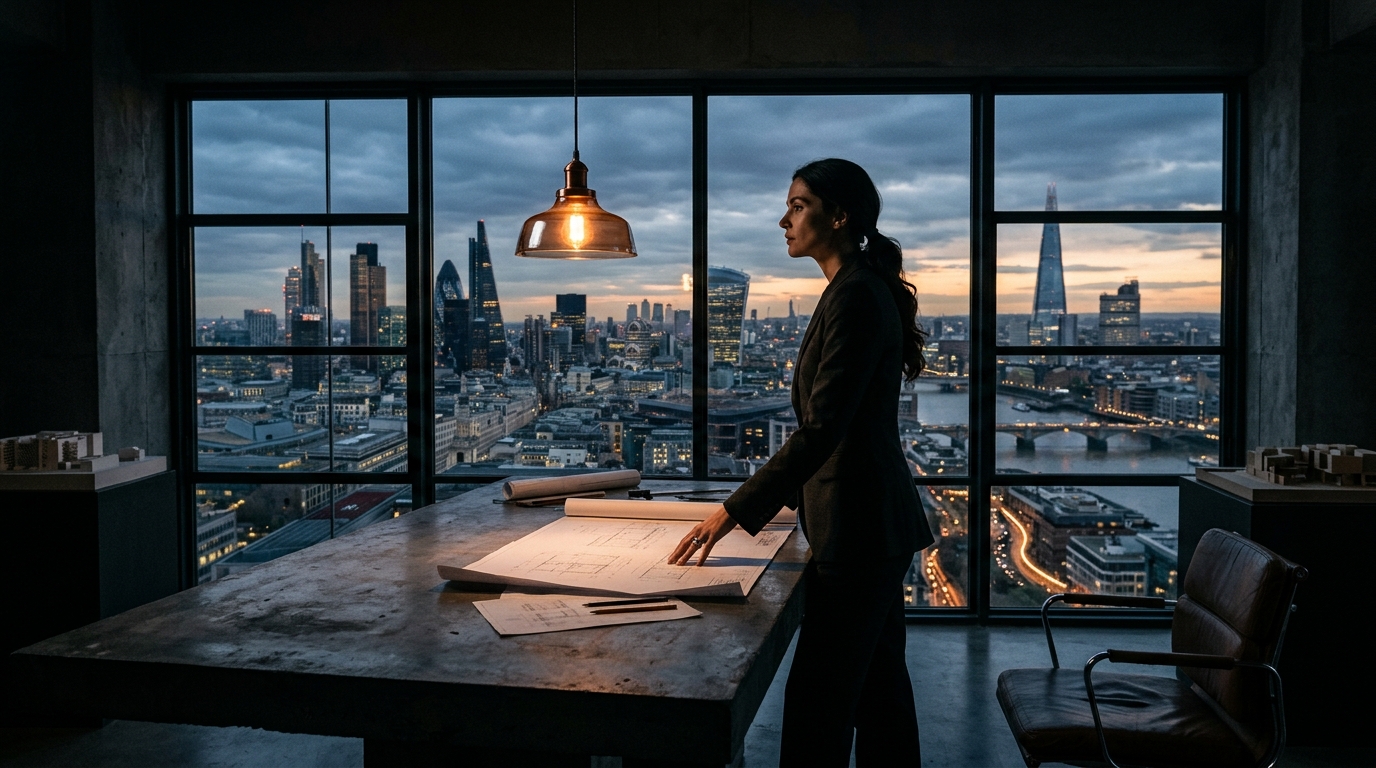
The last light of the Paris afternoon, filtered through the tall, unwashed windows of his atelier, laid long, precise shadows across the floorboards. Adrien, an architect of some renown, known for his stark, almost brutalist lines softened by an unexpected sensuality in materials, ran a hand through his perpetually disheveled dark hair. He was bent over a drafting table, a half-empty glass of cold white wine – a Sancerre, he always preferred its clean, almost mineral bite – beside an intricate blueprint. The scent of old paper, graphite, and something faintly metallic from the T-square hung in the air.
Elodie watched him from the doorway, her presence a silent challenge to the monastic focus he cultivated in this space. She wore a slip of unlined silk, the colour of deep burgundy, its hem just grazing the curve of her thigh. It was an indulgence, a whisper against the skin, rather than a declaration. She hadn’t bothered with lipstick; her mouth was simply hers, full and unadorned.
He didn’t look up immediately, lost in the precise angles of a façade for a private museum in Lisbon. He traced a line with a silver pencil, his brow furrowed. “The cantilever,” he murmured, more to himself than to her, “needs to appear weightless, yet grounded.”
Elodie leaned against the doorframe, a faint smile playing on her lips. “Weightless and grounded. A familiar dilemma, wouldn’t you say?”
Adrien finally lifted his head, his eyes, the colour of slate, meeting hers. The corner of his mouth twitched, a slow acknowledgment. “For buildings, yes. For people… it’s a constant negotiation.” He straightened, stretching his back with a soft groan. “You’re here. I didn’t hear you come in.”
“The latch is rather cooperative when it chooses to be,” she said, pushing off the frame. She walked towards him, her bare feet making no sound on the wood. The silk shifted with each step, a quiet invitation. “You’re working late. Again.”
“The ghosts of the city demand their due,” he said, gesturing vaguely towards the window where the rooftops of Paris were beginning to turn a bruised violet. “They whisper in the blueprints, demanding perfection. Or at least, an approximation of it.” He picked up his wine glass, taking a slow sip. “You look… ready for an evening that isn’t about weightless cantilevers.”
She stopped beside him, close enough for him to catch the faint scent of gardenia from her skin. “Perhaps an evening about a different kind of architecture. One built on different foundations.” Her gaze drifted to the blueprints, then back to his face. “Is that for Lisbon?”
“Indeed. A collector of forgotten objects. He wants a space that feels both ancient and entirely new.” Adrien’s hand, still holding the pencil, reached out, not to touch her, but to gently push a stray strand of hair from her cheek. His touch was light, almost accidental, yet it held a particular current. “Like certain desires, perhaps. Always there, yet always unfolding anew.”
Elodie’s breath hitched, just slightly. “And what does he collect?”
“Memory, mostly. Relics of lives lived intensely. A glove from a forgotten opera singer, a compass that sailed the Arctic, a piece of lace from a queen’s gown.” He paused, his eyes holding hers. “Things that carry stories. Things that hint at what they once contained, without revealing everything.”
She reached for his free hand, her fingers interlacing with his. His palm was warm, calloused from years of drawing and building. “Like the spaces between us, then. The unspoken stories.”
He squeezed her hand gently. “Precisely. The most interesting structures are often those with the most compelling negative space.” He put down the wine, then the pencil. The blueprint lay between them, a silent witness to their slow approach. “Are you suggesting we explore the negative space tonight?”
“I am suggesting,” she said, her voice dropping to a low register, “that the work of the day is done. That even ghosts need their repose.” She let go of his hand, turning slightly, her back to him. The silk of her slip seemed to glow in the fading light. “And that some structures are best experienced from the inside.”
Adrien stepped closer, his presence a warmth at her back. He didn’t speak, but his fingers, tentative at first, then more assured, traced the line of her spine through the silk. The fabric, so thin, offered little resistance. He felt the delicate ridge of her vertebrae, the subtle curve of her waist. A shiver ran through her, not of cold, but of a quiet recognition.
He leaned in, his lips brushing the sensitive skin behind her ear. “The client for this museum,” he murmured, his voice a low thrum against her skin, “insisted on a certain… reverence for absence. For the quiet places where meaning truly resides.”
Elodie turned slowly in his arms, her eyes half-closed. “And you, Adrien? What do you insist upon?”
He looked at her, his slate eyes darkening with a precise, contained intensity. “That the foundations are sound. That the proportions are harmonious. And that the space, once entered, feels entirely, undeniably real.” His hands moved, gently, to cup the small of her back, drawing her closer until the silk of her slip met the rough linen of his shirt.
The last of the dusk bled from the windows, leaving the atelier in a soft, encroaching gloom. The blueprints remained on the table, forgotten. The city outside began its evening hum, a symphony of distant sirens and muted laughter, but in the quiet of Adrien’s studio, only the subtle shifting of fabric and the quickening of breath marked the changing of the hour. There was a particular elegance, he thought, to an intimacy born not of haste, but of patient, considered design.