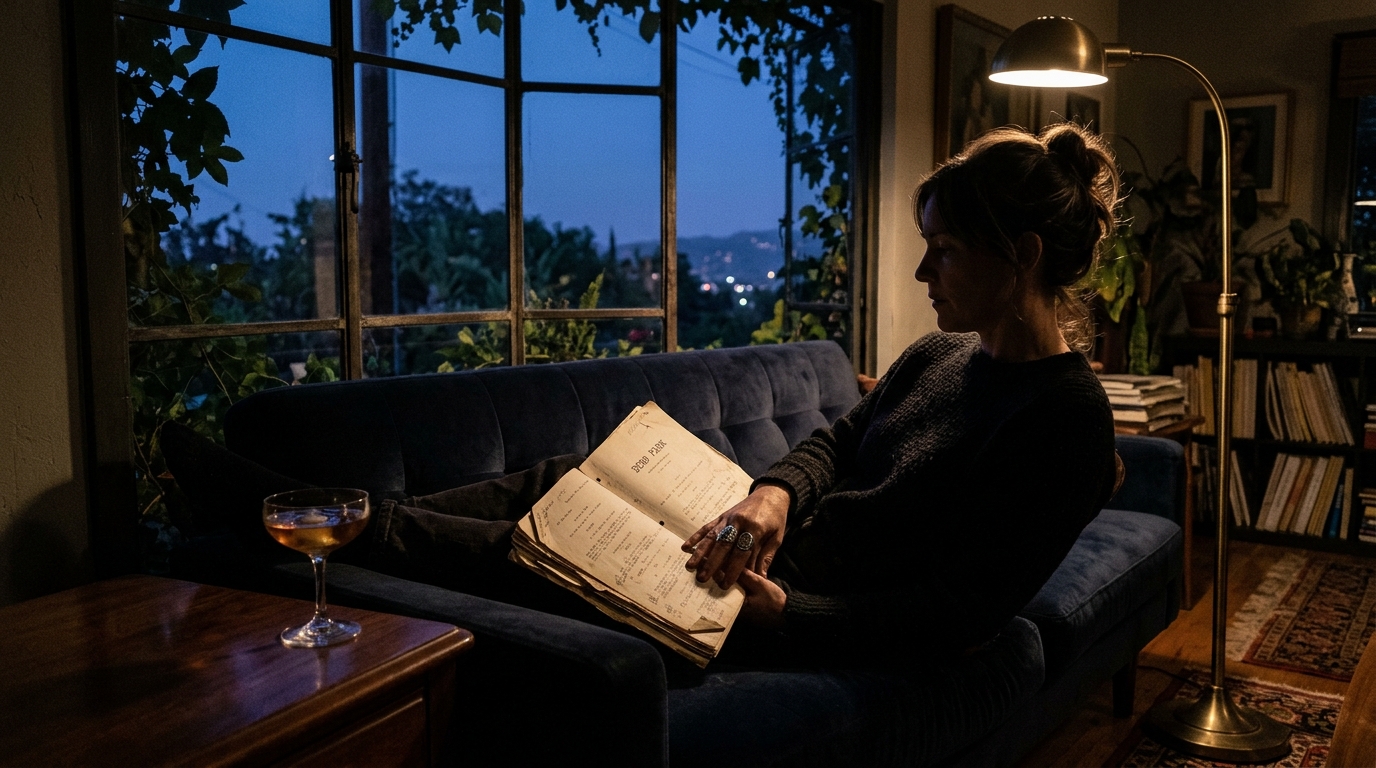
The late afternoon sun, filtered through the eucalyptus leaves outside, cast long, wavering shadows across the worn Persian rug in the Echo Park bungalow. A single beam caught the dust motes dancing above the mahogany coffee table, where two half-empty glasses of cold white wine stood, condensation rings blooming on the polished surface. Elara, her dark hair pulled back loosely, sat on the deep velvet sofa, her posture a study in contained tension. Across from her, on an armchair that seemed a decade too old for the space, sat Julian, his tailored linen shirt unbuttoned at the cuff, revealing a sliver of wrist.
“Another round of impossibles, then,” Julian said, his voice a low rumble, devoid of any discernible emotion. He swirled the remaining wine in his glass, the liquid catching the light.
Elara offered a small, almost imperceptible smile. “Or a testament to the fact that everyone wants to be seen, but few understand the terms of the gaze.” She picked up her own glass, the stem cool between her fingers. “Especially in this city. They come in, eyes wide, believing the lens is simply a mirror.”
“And you disabuse them of the notion,” Julian said, a hint of something—amusement, perhaps, or resignation—in his tone. He leaned forward, resting his forearms on his knees. “The casting director as a kind of secular confessor, revealing their true selves, not to God, but to the industry.”
“Only if their true selves align with the studio’s quarterly projections,” Elara corrected, a dry precision in her words. She took a slow sip. “It’s rarely about revelation. More often, it’s about a finely tuned performance of vulnerability. A performance they’ve often rehearsed in their bedrooms, imagining the bright lights, the whispered admiration.”
Julian watched her, his gaze steady, observant. He had known Elara for years, since their early days in New York, when she was still interning in a small indie film office and he was struggling to launch a theatre company that ultimately failed. There was a particular kind of candor between them, built on shared disappointments and a cynical appreciation for the machinery of their respective crafts.
“And you, Elara,” he said, shifting slightly, the leather of the armchair creaking softly. “What performance are you rehearsing these days? The detached observer? The unyielding gatekeeper?”
A faint flush rose to Elara’s cheeks, a subtle disruption to her composed exterior. “I stopped rehearsing a long time ago, Julian. Now, I merely observe. It is a safer position.”
He chuckled, a low, intimate sound that seemed to fill the quiet room. “Safer, perhaps. But less… vivid. I remember a time when your observations were less clinical, more… engaged.” He paused, letting the implication hang in the air, a delicate thread pulled taut.
Elara met his gaze, her own eyes dark and unreadable. The shadows outside lengthened, the room growing dimmer, the details of their faces softened by the encroaching twilight. “Circumstance changes us. Ambition, too. The desire to simply be rather than to perpetually become.”
“And what if becoming is the only way to truly be?” Julian pressed, his voice softer now, a subtle persuasion in its cadences. He picked up the wine bottle from the floor beside him, a cool condensation still clinging to its dark glass. “More wine? Or shall we move to something stronger? Perhaps a memory?”
She considered him, her posture relaxing almost imperceptibly. The sound of a car passing on the street outside, a distant siren, faded into the quiet hum of the room. The air was thick with the scent of jasmine from the garden, and something else – the faint, earthy smell of old books and the crisp, clean scent of his linen shirt.
“Memories are unreliable narrators,” Elara said, a hint of vulnerability now in her voice, a crack in the carefully constructed facade. “They embellish. They omit.”
“Which is why we must cross-reference,” Julian countered, his lips curving into a slow, knowing smile. He poured a small amount of wine into her glass, the liquid gleaming like amber in the fading light. “Come, Elara. The day is almost done. Let the scripts fall away for a moment. Let us simply… inhabit the scene.”
He rose from the armchair, his movements fluid and unhurried. The faint scent of his cologne, a subtle blend of cedar and citrus, reached her. He walked to the window, pulling back the thin curtain, and for a moment, his silhouette was sharply defined against the last blush of the Los Angeles sunset.
“Look,” he said, his voice quiet. “Even the city knows how to perform a final act. A spectacle of light, before the quiet darkness.”
Elara watched him, the curve of his back, the way his hand rested on the window frame. The memory he alluded to, unspoken, was not so much unreliable as it was inconvenient. A memory of a different kind of intensity, a different sort of script they had once improvised together. The silence between them stretched, not empty, but resonant, filled with the weight of years and unspoken desires. She felt a subtle shift within her, a loosening of the carefully tied knots. The cold white wine felt suddenly insufficient.
“Perhaps,” Elara conceded, her voice barely a whisper, “a different kind of beverage is indeed called for. A different kind of scene.” She met his eyes across the deepening shadows of the room, and a flicker, quick as a match striking in the dark, passed between them. The air grew still, charged with an anticipation that felt both ancient and entirely new. The click of a latch, a door slowly opening onto an untold possibility.