
There is a peculiar melancholy that descends when the last vestiges of polite artifice, of considered distance, vanish from a shared life. When the door no longer clicks with a deliberate finality, but hangs ajar; when the clothes are no longer chosen with an eye toward admiration, but pulled on from a heap; when even the most intimate moments lose their choreography, becoming a casual, almost perfunctory exchange. We imagine such unvarnished familiarity as the zenith of love, a testament to unshakeable comfort. Yet, often, it is merely the quiet extinguishing of a flame that once thrived on the friction of anticipation, the cool promise of what was still veiled.
Eliza adjusted the thin wire spectacles on her nose, the lamplight catching the dust motes dancing in the late afternoon air of the archive. The scent of aged paper and dry ink, a quiet, almost spiritual perfume, always calmed her. Today, however, a restlessness prickled beneath her skin. The letter in her gloved hands, dated 1907, spoke of a clandestine meeting in a Parisian atelier, of a “whispered confidence beneath the rustle of silk,” of a desire so potent it seemed to hum through the brittle page. It was signed simply, “V.”
“Anything scandalous today, Eliza?”
The voice, dry and amused, belonged to Dr. Adrian Thorne, who materialized silently beside her, a habit he’d perfected over their years of shared tenure. Adrian, with his silvering temples and the perpetual half-smile that barely touched his eyes, specialized in early 20th-century geopolitical correspondence. Their paths rarely intersected in the more intimate corners of the collection.
Eliza allowed a small, almost imperceptible smile to play on her lips. “Depends on one’s definition of scandal, Adrian. This one is more a matter of exquisite restraint.” She held the letter up, careful not to wrinkle it. “He writes of the unbearable beauty of her gloved hand resting on his sleeve. Not even the touch of skin, mind you.”
Adrian peered over her shoulder, his gaze lingering on the elegant script. “Ah, the Edwardians. Masters of the unsaid. We’ve rather lost that art, haven’t we? Everything is laid bare, like a blueprint, or a medical chart.” He paused, then added, almost to himself, “And somehow, less is revealed.”
A faint flush rose on Eliza’s cheeks. She knew Adrian wasn’t referring to the Edwardians alone. Their own relationship, a carefully calibrated professional friendship, was built on a similar architecture of elegant withholding. They spoke of history, of philosophy, of the subtle nuances of language, but never of themselves beyond the most superficial pleasantries. It was a comfortable equilibrium, but occasionally, as now, the ghost of a question stirred.
“Perhaps,” Eliza said, turning the letter over. “Or perhaps the stakes were higher then. A reputation, a fortune, an entire social fabric could unravel with a single misplaced word, a single unguarded touch.”
“And now?” Adrian countered, a playful glint in his eye. “Now we speak of ‘emotional labor’ and ‘transparent communication.’ We dissect every tremor, every subtext, until the mystery is eviscerated. What is left to desire when everything is already known, already cataloged?”
He leaned closer, his voice dropping to a near whisper, “Imagine the thrill of that gloved hand, Eliza. The anticipation. The sheer force of imagination it must have required to sustain such a desire. More potent, perhaps, than any physical act.”
Eliza felt a shiver trace its way down her spine, not from the chill of the archive, but from the unexpected intimacy of his words. His breath, smelling faintly of coffee and old books, was warm against her ear. The air between them, usually so clear and unburdened, suddenly felt charged, dense with unspoken possibilities.
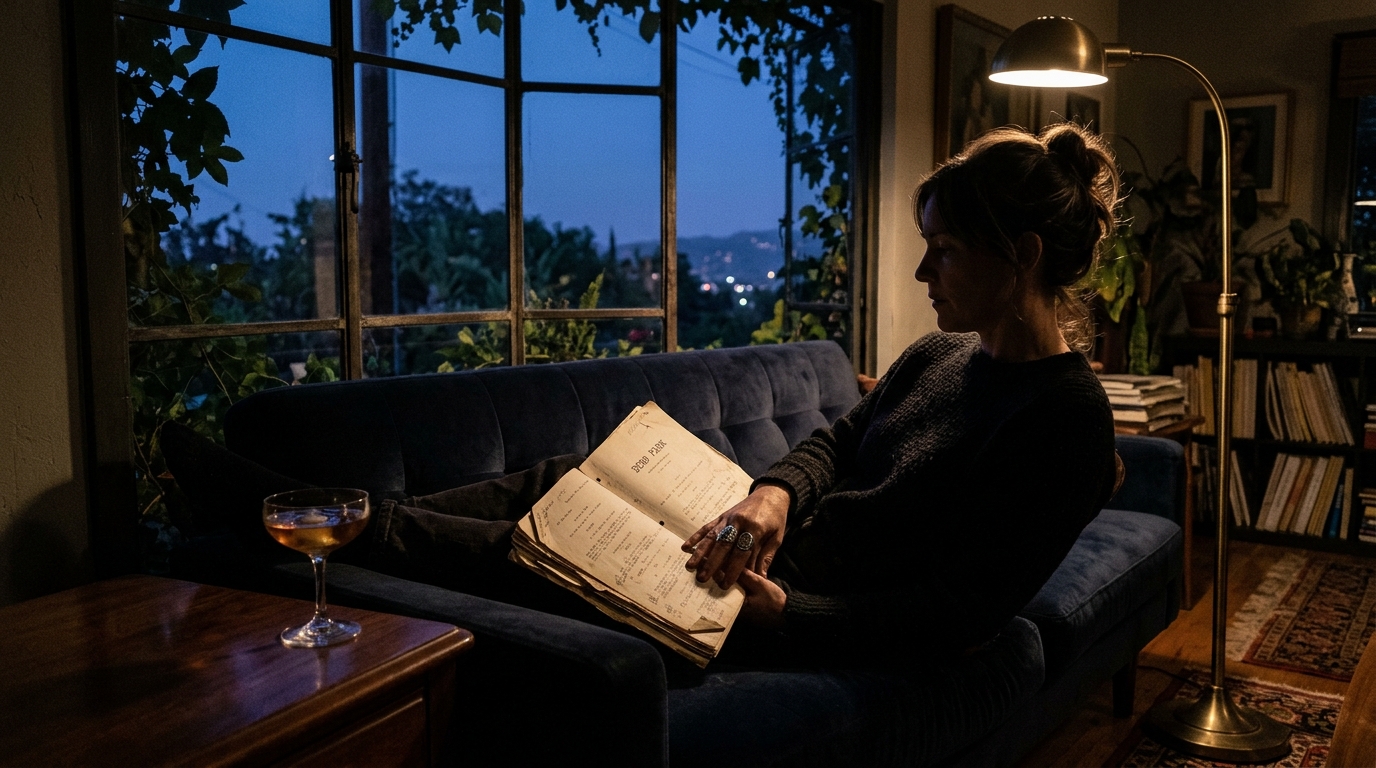
Later that evening, in her quiet apartment, Eliza found herself staring at the rain-streaked window, a glass of cold white wine in her hand. The Edwardian letter lay on her polished mahogany table, a tangible whisper from another era. Adrian’s words echoed in her mind: “What is left to desire when everything is already known, already cataloged?”
She thought of the men she had known, the relationships that had, like over-pruned roses, withered from too much exposure. The relentless need to explain, to define, to justify every flicker of emotion until the emotion itself was reduced to a sterile specimen under a microscope. The modern insistence on complete transparency, she mused, was often a veiled form of control, a demand to strip away the very qualities that made another human being a compelling landscape to explore.
She walked to her small, uncluttered bedroom. Her silk dressing gown, unlined and the color of midnight, lay draped over a chair. As she slipped it on, the fabric cool and smooth against her skin, she caught her reflection in the full-length mirror. A woman of forty-five, with a quiet intelligence in her eyes, a certain elegant reserve that had served her well. But tonight, a new question flickered in those eyes.
She pulled out a small leather-bound journal from her bedside drawer, a gift from her grandmother. On the first page, in her own neat hand, was a quote from a forgotten poet: “The deepest currents flow where the surface is calm.”
She closed her eyes, Adrian’s voice a low hum in the back of her mind. That spark in his eyes, the almost imperceptible tilt of his head as he had spoken of the gloved hand. Had it been merely academic interest, or something else? Something… withheld?
The following morning, Eliza arrived at the archive earlier than usual. She saw Adrian at his usual desk, already immersed in a stack of diplomatic papers. As she walked past, she paused.
“Adrian,” she said, her voice softer than usual.
He looked up, a slight surprise in his expression. “Eliza. Good morning.”
“I was thinking about our conversation yesterday,” she began, a hint of vulnerability in her tone. “About the gloved hand.”
Adrian set down his pen, his full attention now on her. “And?”
“Perhaps,” she said, a small, deliberate smile curving her lips, “we’ve forgotten the allure of the uncataloged.”
He studied her for a long moment, the silvering at his temples catching the first rays of morning sun streaming through the high arched windows. A slow smile spread across his face, reaching his eyes this time. It was a smile that promised, perhaps, a shared rediscovery. A quiet, knowing acknowledgment passed between them, a silent agreement that some things, like the most precious letters, were best left to be traced, not entirely revealed, and always with a certain exquisite care. The click of the archive’s heavy oak door, now securely shut, echoed the sound of a new, subtle formality beginning to take root.